3. The Animals Film (Beyond the Frame 1981, 137min)
To my knowledge, The Animals Film was the first documentary to me made on the animal protection movement and the first to be aired on public television--an amazing feat given that it was released just 6 years after the publication of Animal Liberation, 1 year after Henry Spira's ad campaign against Revlon, 2 years before The Case for Animal Rights, and 3 years before Unnecessary Fuss. Filmed in the United States by an Israeli and released in England, TAF had been the most comprehensive film on animal welfare up until the release of Earthlings 16 years later. Yet, despite its age, sadly, little has changed since its release except that industry practices and problems have increased in magnitude and extended into other countries. (In 1980, about 5 billion animals were slaughtered in America annually compared to nearly 9 billion by 2000). In fact, it is my opinion that despite the praise for Earthlings and the absence of knowledge about this film, TAF is better. (Whether it is more effective at recruiting vegans--Earthlings supposedly is nicknamed "the Vegan maker"--, that is for empirical studies to determine).
Sunday, August 29, 2010


Saturday, August 28, 2010
Moving Animals: Spectacular Animal Films (Part 1)
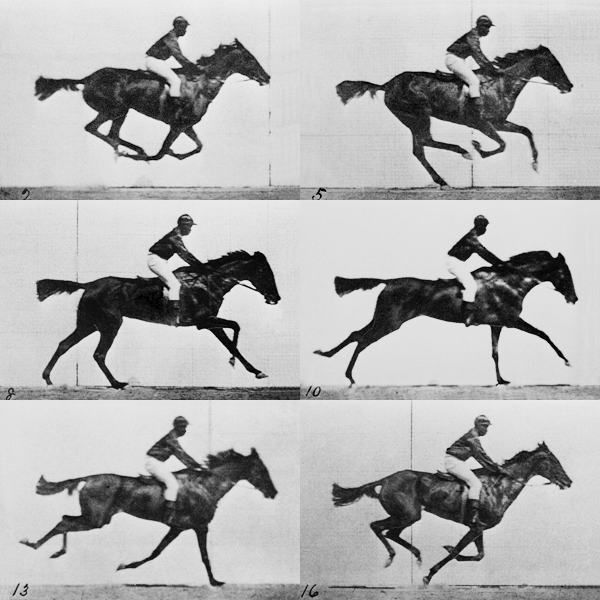 |
| Eadweard Muybridge's "The Horse in Motion" (1878) |
--Jim Mason in An Unnatural Order (2005 [1993])
“The animal look can be seen as a continuation of the photographic look... Animals appeared to merge with technological bodies that replaced them... If the animal cannot die but is nonetheless vanishing, then it must be transferred to another locus, anther continuum in which death plays no role... the cinema developed, indeed embodied, animal traits as a gesture of mourning for the disappearance of [animals]"
--Akira Lippit in Electric Animal (1998)
Moving Animals, Animal Affect, and Effective Movies
Since its inception, the animal movement has relied upon images to evoke sympathy--from William Hogarth's "The Four Stages of Cruelty" (1751) that connected cruelty to animal to cruelty to humans, to the anti-vivisectionist posters that re-figured the medical oppression of women to that of animal others, and PETA's "Holocaust on Your Plate" and "Animal Liberation" exhibits that juxtaposed images of human and nonhuman oppression. Undercover investigation footage of labs, in particular, played a crucial role in the 1980's, especially within the efficacy of the ALF and PETA (videos like Unnecessary Fuss and Inside Biosearch). However, with increased vandalism and exposure, the Animal Industrial Complex has been vigilant to guard its practices from public knowledge. Since the 1990's, these industries have installed hi-tech security systems in addition to lobbying for the Animal Enterprise Terrorism Act [AETA], which gained increasing government backing post-9/11. Such footage, has been crucial to educating the public about animal welfare within the age of televisions, computers, and cinema. Over the last decade, activists have even accompanied themselves with video harnesses to literally carry the animals' voices to protests and demos.
Tuesday, August 17, 2010
Social(ist) Animals: Toward Mutual Aid against the Great Butcher
 | |
| Sue Coe. 2004. "Ox Pull." From "Bully!: master of the Global Merry-go-round" Source: http://www.graphicwitness.org/coe/bullya.htm |
Introduction
Ten months ago, Paul D'Amato's article "Socialism and 'animal rights'" sparked a small controversy that fizzled out within a month of its release. Unfortunately, out of the dozen responses only two or three were more argument than opinion. My aim here is to provide a more rigorous and comprehensive critique of D'Amato's article absent in the responses in order to better reconcile the perceived tension between socialistm and animal rights.
In "Socialism and 'Animal Rights'," D'Amato's reasoning starts off strong, making critical and important insights on the idea of animal liberation; however, it soon strays into weak, dangerous, and unnecessary territory. D'Amato comes to several conclusions (not presented in this order):
- "There is a clear connection between how a rapacious capitalism mistreats animals... environment... [and] human[s]"
- "Non-human animals are helpless… incapable of organizing and fighting for their rights"
- "To compare the condition of animals to that of... [humans] for freedom and equality is to view the latter through a paternalistic lens, rather than a lens of human liberation"
- "we need to insist on the essential differences between human beings and other animals, and reject the idea of 'animal liberation.'"
- "seeking more humane treatment of animals is not the same as calling for 'animal rights'"
I'm totally on board with D'Amato's thesis if we are only discussing movements and not also mental, material, and legal outcomes. But he does not enclose his argument to his thesis; he continues on to argue that humans are essentially different from all other animals (despite being careful to say that humans are only "qualitatively" different"), and that the "liberation" and rights of nonhuman animals be rejected in favor of merely "more humane treatment." It is these last two conclusions, I find objectionable and weakly argued.
In this response, I will critique four positions D'Amato either asserts or ignores. First, he implicitly argues that one cannot have rights unless one asserts one has them, a contractualist argument that would exclude many humans from possessing rights. Second, he explicitly draws on evolutionary biology to make arguments for an essential difference between humans and other animals that contradict themselves and are analogous to arguments that have been used to rationalize racism. Third, D'Amato misses how worker and animal exploitation are not only increased by capitalism, but that they are intersecting oppressions that mutually reinforce one another just as socialism and animal rights are ethico-political positions that intersect and mutually reinforce one another. Finally, he is naive to the historical, cultural, and ecological ties between the exploitation and well-being of human and animal.
Saturday, August 14, 2010
Deconstructing Veganism: Commodity, Reciprocity, & the Killing Contract

As I previously mentioned, most of my blogging over the last year has been on Facebook. I do not have the time to write as masterful posts with extensive and precise citations as before, so I cannot promise future posts will be as organized and nuanced as previous ones. That said, although I have not done so in the past here, future posts like this one will be in response to either a provocative blog entry elsewhere on the web or several related news stories. If we are both so lucky, these posts will probably be shorter reads. Well, we'll see!
Insturmentalism: the Logos of Animal Capital
Anastasia @ Animal Visions, a highly welcomed blog that just hit the cyber-scene, writes in "What’s the deal with animal use?":
From an ecofeminist and indigenous perspective, use of another living being is not inherently bad; in fact, it’s necessary for survival. The use becomes a major problem when it’s one-sided. That is, living beings in the ecosystem are made... into resources in order to serve one species, and members of that species do not give back in response to what they have received. ... What’s missing in this scenario is reciprocity, which is also missing in our conceptualization of exploitation... The act of “use” wouldn’t be a problem because everyone would be used, and the use would simply be an act of life, a way of participating in the biosphere. Alas, as it stands, we do not. Our global civilization exploits many and holds no values for giving back...I really like this and is kind of what I've been thinking about for several years and why I share Donna Haraway's (2007) criticism of abolitionist views that always cast nonhuman animals as victims, ignoring their agency and affect upon humans. Animal rightists have overlooked that their positioning of nonhuman animals as "voiceless", "defenseless," and "helpless" have only re-instituted their passivity, having presupposed a human-reason-agent vs nonhuman-passive dualism. Writers like Haraway, but especially James Hribal (2003, 2006, 2007, 2010), have repositioned animals not as slaves, a la Marjorie Speigel's Dreaded Comparison (1996), but as "the working class." Reconfigurations of animals as fellow agents on the one hand may affirm their subjectivity and role in society, while on the other risks reinstating their oppression on new terms (as I will argue against reciprocity being a sufficient condition for ethical relations).
Do animal liberation proponents really want to abolish all forms of animal use, thereby disregarding our interdependence in the biosphere and severing any possibility for us to give unto other animals and to be open to our use in return? This animal liberation proponent certainly doesn’t.
Wednesday, August 11, 2010
Sperm Banks & Meat-Markets: The Sexual Economy of Meat
"$uper Cow", $uper Profits: Cyber Chattel, $ex Exchange, and $perm Banks
In a recent National Geographic program on the technoscientific management of "nature," we get a glimpse at a very much neglected element in contemporary animal agribusiness, the sperm banks by which, animals are, according to Jacques Derrida (1997), "exterminated by means of their continued existence or even their overpopulation”:
In a recent National Geographic program on the technoscientific management of "nature," we get a glimpse at a very much neglected element in contemporary animal agribusiness, the sperm banks by which, animals are, according to Jacques Derrida (1997), "exterminated by means of their continued existence or even their overpopulation”:
Selective breeding is the first stop on our tour of how man is using science to control nature... In fact, selective breeding is all about managing sex...Over a hundred years, Farmers have only allowed the cows and bulls with the largest muscle mass to mateThe technoscientific sacrifice of animal heathcare for economic welfare is explained:
There is a gene that regulates the growth of muscles in cattle. These cows have been selectively breed from animals that contain a copy of this gene that doesn't work. As a result their muscles grow far larger than normal. To insure that the effective gene is passed on, sex for the Belgian Blues has been replaced by technology in the form of artificial selectionThe men in the video discuss the homoerotic, predatory gaze:
The bulls are shaved to best display their muscles... so you can see where all the meat is... because when you look at him, you cannot help but think of lunch
Thursday, June 17, 2010
Update: Taste of Yesterday and Tomorrow

Don't worry, I've been at work on a pretty interesting piece called "Weakening Veganism: Intersectional, International, Interspecies Conversations." In it, I argue that veganism should be thought of as a conversational process with others that affirms and enriches human-animal relationships rather than an antagonistic identity based on following a fixed moral system based on abstaining from human-animal relationships. You can get a taste of it by visiting the "Paradigm Shift" page.(Yep, it's a new feature just like the "About" and "Table of Contents" pages. I may also try adding a "Video" page, too.)
If you're an old reader, you'll notice the blog has undergone a major template change... and I love it! Yeah, it's not green, but I like the earthiness of the browns. And it's damn sexy, too. But I'm not opposed to changing things around if people have suggestions.
In other news, I will be presenting a paper called "Queering the Breast: De-Naturing the Hu/man through Breastfeeding Practices" that articulates a new relationship between humans, animals, and food based on experience, transformation, and nourishment. It's based on the "The Identity Politics of Breasts" series I posted last summer and is a hybrid creature of animal, feminist, queer, and trans* studies. I hope to get this published in an upcoming special issue on animals in Hypathia. I also plan on publishing a refined version of my "The Racial and Colonial Politics of Meat" when I get the chance in addition to a piece on "Animal Anarchist Ethics in the Flesh" based on the "Weakening Veganism" post described above. So that's a taste of what's to come.
Finally, most of my blogging has been done on Facebook. I usually type responses to other blogs and new pieces that are maybe 200-500 words without any citations.Would people prefer I post these on here?
I've been reluctant because I've tried to maintain very high quality posts, but, then again, its only a blog. Also, 2) how much would you prefer shorter posts--does anyone read through the whole thing ever?
Throw some feedback at me if you're interested in any of this!
Wednesday, June 16, 2010
Vegan logos, 11 Reasons
 So I was recently asked by someone why I was vegan. Oddly, this hadn't been something I had thought about recently, so I decided to go through my reasoning. I wanted to keep it short, but you know me! The point is, I'm trying to capture the bigger picture within a linear narrative that, while simplified, still captures some nuance. Let me know what you think I may turn this into a pamphlet. Am I missing something?
1. Nonhuman animals are sentient
2. Nearly all animals raised for food today suffer tremendously.
3. The problem is institutional and of use, not merely cruelty.
4. Discrimination and Contradiction.
5. Killing animals for food involves either self-deception or habituation to violence.
6. Meat is a symbol and legitimator of power and hierarchy.
7. One cannot meet the global demand for meat while fairly feeding the world.
8. The current world consumption of animals is unsustainable.
9. Veganism is the practice of social and ecological justice.
10. It doesn’t matter whether eating animals is natural.
11. Veganism is fun and delicious!
Wednesday, December 2, 2009
Eating our Way to Global Citizenship
Eating our Way to Global Citizenship:
A Rumination on the Role of International Education in Creating a Sustainable Future of Food and Identity
A Rumination on the Role of International Education in Creating a Sustainable Future of Food and Identity

“The lesson of ecology is that one cannot care for the future of the human race without caring for the future of its context… A land ethic, on this view, is the moral thread that links past, present, and future individuals in a common culture. That culture can be perpetuated only if it respects limits inherent in the land context—for continuity in that land context gives shared meaning to cultures as they unfold through time.” -- Bryan Norton in Toward a Unity Among Environmentalists (1991,219)“All education is environmental education,” writes environmental educator David Orr. “By what is included or excluded we teach the young that they are part or apart from the natural world.” Likewise could be said about an international education of food. While environmental and international education have grown more prominent in the 21st century, food has been relatively neglected as a subject within both international and ecological contexts in proportion to its role in environmental justice. Food ought to be among the highest priorities of all people concerned with the world’s one billion hungry people, the thousands of children who die daily of malnutrition, and the irreversible disappearance of Earth’s biocultural diversity. In the context of food, addressing sustainability requires a concern for not only economy and society, but culture and individual human life as well. Far from a private, domestic concern, eating fair and sustainable food is one aspect of becoming a global citizen.
Subscribe to:
Posts (Atom)