Wednesday, February 1, 2012

Animal Theory, Going Feral in 2012

Since the late 1970s, scholarship in the field of human and nonhuman animal relations--a development of animal, environmental, and social liberation movements--has significantly developed, testing the limits of the humanism and liberalism that gave birth to it. In the 1980s and 90s, philosophers, historians, sociologists, anthropologists, feminists, socialists, and literary theorists have contributed to this academic and cultural project. Research in human and non-human animal relations has particularly come into vogue in the last decade. This new literature developed out of increasing interdisciplinary as well a younger generation with more radical political ambitions, those who were dissatisfied with the presuppositions and/or simplicity of earlier theory.

Below are a few lists of books published between 2010 and 2012 that I would love to read by the end of the year; books such as Zoopolis which re-conceptualizes interspecies ethics as interspecies justice, Critical Theory and Animal Liberation which organizes the most sophisticated collection of critical animal studies theory to date, Creaturely Poetics which articulates a movement in animal ethics away from reason and power toward vulnerability, and Social Lives with Other Animals which investigates the social formation of species identity within the particular intersections of oppression. Animalkind, Beyond Animal Rights, and Animal Ethics in Context further challenge the traditional and universal morality espoused by animal advocates for more nuanced considerations that are far from self-certain. And if these books aren't tricky enough, the first philosophy book entirely dedicated to the moral considerability of plants, Plants as Persons, is bound to give the zoocentrist a run for her money.

Tim Tyler's book CIFERAE and Dominic Pittman's Human Error, and Boddice's Anthropocentrism add further complexity to our understanding of our humanity and the hegemony of anthropocentrism while Pat Shippman and Hal Herzog explore the myths of human-animal relationships with the latest empirical research in anthropology and psychology. Then there is Meat, Animals and Public Health, and Animals as Biotechnology which offer meditations on the relationship between our treatment of animals and the intersections of human, animal, and ecological health. Last but not least, I'm majorly anticipating Kari Weil's Thinking Animals, which seems like it will provide the greatest synthesis of human-animal studies yet published.


If you are interested in contributing a book summary and review to be posted on this blog, please send me an email or comment below.

NEW DIRECTIONS IN ANIMAL ETHICS / JUSTICE:
Zoopolis: A Political Theory of Animal Rights (Sue Donaldson, Will Kymlicka, 2012)
Zoopolis offers a new agenda for the theory and practice of animal rights. Most animal rights theory focuses on the intrinsic capacities or interests of animals, and the moral status and moral rights that these intrinsic characteristics give rise to. Zoopolis shifts the debate from the realm of moral theory and applied ethics to the realm of political theory, focusing on the relational obligations that arise from the varied ways that animals relate to human societies and institutions. Building on recent developments in the political theory of group-differentiated citizenship, Zoopolis introduces us to the genuine "political animal". It argues that different types of animals stand in different relationships to human political communities. Domesticated animals should be seen as full members of human-animal mixed communities, participating in the cooperative project of shared citizenship. Wilderness animals, by contrast, form their own sovereign communities entitled to protection against colonization, invasion, domination and other threats to self-determination. `Liminal' animals who are wild but live in the midst of human settlement (such as crows or raccoons) should be seen as "denizens", resident of our societies, but not fully included in rights and responsibilities of citizenship. To all of these animals we owe respect for their basic inviolable rights. But we inevitably and appropriately have very different relations with them, with different types of obligations. Humans and animals are inextricably bound in a complex web of relationships, and Zoopolis offers an original and profoundly affirmative vision of how to ground this complex web of relations on principles of justice and compassion.


Critical Theory and Animal Liberation (John Sabonmatsu, 2011)
Critical Theory and Animal Liberation is the first collection to approach our relationship with other animals from the critical or 'left' tradition in political and social thought. Breaking with past treatments that have framed the problem as one of 'animal rights,' the authors instead depict the exploitation and killing of other animals as a political question of the first order. The contributions highlight connections between our everyday treatment of animals and other forms of social power, mass violence, and domination, from capitalism and patriarchy to genocide, fascism, and ecocide. Contributors include well-known writers in the field as well as scholars in other areas writing on animals for the first time. Among other things, the authors apply Freud's theory of repression to our relationship to the animal, debunk the 'Locavore' movement, expose the sexism of the animal defense movement, and point the way toward a new transformative politics that would encompass the human and animal alike.

Creaturely Poetics: Animality and Vulnerability in Literature and Film (Anat Pick, 2011)
Simone Weil once wrote that “the vulnerability of precious things is beautiful because vulnerability is a mark of existence,” establishing a relationship between vulnerability, beauty, and existence transcending the separation of species. Her conception of a radical ethics and aesthetics could be characterized as a new poetics of species, forcing a rethinking of the body’s significance, both human and animal. Exploring the “logic of flesh” and the use of the body to mark species identity, Anat Pick reimagines a poetics that begins with the vulnerability of bodies, not the omnipotence of thought. Pick proposes a “creaturely” approach based on the shared embodiedness of humans and animals and a postsecular perspective on human-animal relations. She turns to literature, film, and other cultural texts, challenging the familiar inventory of the human: consciousness, language, morality, and dignity. Reintroducing Weil’s elaboration of such themes as witnessing, commemoration, and collective memory, Pick identifies the animal within all humans, emphasizing the corporeal and its issues of power and freedom. In her poetics of the creaturely, powerlessness is the point at which aesthetic and ethical thinking must begin.

Social Lives with Animals: Tales of Sex, Death and Love (Erika Cudworth 2011)
The conventional trilogy of social domination, of class, 'race' and gender has been challenged by new concerns around other distinctions – of place and location, age and generation, sexuality and forms of embodied difference. Despite these important developments, sociology has mostly stopped short at the difference of species. Erika Cudworth draws on various traditions of critical theorizing in sociology and animal studies in arguing that the social is not exclusively human and that species should be understood as a complex system of social domination which is co-constituted with intra-human social dominations. This understanding of species as a social system of relations is exemplified through three case studies: the eating of animals as food, the rearing of animals in industrial agriculture and the keeping of animals as companions. These sites reveal ways in which relations of species domination shape the lives both of humans, and of domesticated animals. Social Lives with Other Animals is a critical sociology of species which takes us beyond theories of speciesism or anthropocentricity and presents a necessary challenge to the power relations in the social formations of species.

Animalkind: What We Owe to Animals (Jean Kazez, 2010)
By exploring the ethical differences between humans and animals, Animalkind establishes a middle ground between egalitarianism and outright dismissal of animal rights. A thought-provoking foray into our complex and contradictory relationship with animals. Advocates that we owe each animal due respect. Offers readers a sensible alternative to extremism by speaking of respect and compassion for animals, not rights. Balances philosophical analysis with intriguing facts and engaging tales

Beyond Animal Rights: Food, Pets, and Ethics (Tony Milligan, 2010)
Issues to do with animal ethics remain at the heart of public debate. In "Beyond Animal Rights," Tony Milligan goes beyond standard discussions of animal ethics to explore the ways in which we personally relate to other creatures through our diet, as pet owners and as beneficiaries of experimentation. The book connects with our duty to act and considers why previous discussions have failed to result in a change in the way that we live our lives. The author asks a crucial question: what sort of people do we have to become if we are to sufficiently improve the ways in which we relate to the non-human? Appealing to both consequences and character, he argues that no improvement will be sufficient if it fails to set humans on a path towards a tolerable and sustainable future. Focusing on our direct relations to the animals we connect with the book offers guidance on all the relevant issues, including veganism and vegetarianism, the organic movement, pet ownership, and animal experimentation

Animal Ethics in Context (Clare Palmer, 2011)
It is widely agreed that because animals feel pain we should not make them suffer gratuitously. Some ethical theories go even further: because of the capacities that they possess, animals have the right not to be harmed or killed. These views concern what not to do to animals, but we also face questions about when we should, and should not, assist animals that are hungry or distressed. Should we feed a starving stray kitten? And if so, does this commit us, if we are to be consistent, to feeding wild animals during a hard winter? In this controversial book, Clare Palmer advances a theory that claims, with respect to assisting animals, that what is owed to one is not necessarily owed to all, even if animals share similar psychological capacities. Context, history, and relation can be critical ethical factors. If animals live independently in the wild, their fate is not any of our moral business. Yet if humans create dependent animals, or destroy their habitats, we may have a responsibility to assist them. Such arguments are familiar in human casesùwe think that parents have special obligations to their children, for example, or that some groups owe reparations to others. Palmer develops such relational concerns in- the context of wild animals, domesticated animals, and urban scavengers, arguing that different contexts can create different moral relationships.

Thursday, July 28, 2011

Let Them Eat Meat: An Interview by an Ex-Vegan

INTRODUCTION
Rhys Southan's interview of me on his ex-vegan blog, Let Them Eat Meat, went up this morning. According to Rhys:
If anyone could convince me that I’m wrong about veganism, it’s Adam... [T]he interview is worth reading if you’re curious to see the strongest formulation of vegan beliefs that I’ve seen.
Please check out the interview if you haven't read my posts this summer. (Below I've included some not previously posted excerpts from the interview and several links to challenging articles written by Rhys).

Questions in the interview include:
  1. What do you believe is wrong with the standard consumer veganism that the most mainstream advocates promote?
  2. How would you describe the form of veganism that you advocate?
  3. Most vegan solutions for ending the exploitation and killing of animals (animal liberation) seem to require a human/animal separatism. How would your idea of veganism avoid that?
  4. Why do you refer to animals that aren’t humans as “animal others”?
  5. Is veganism a moral obligation?
  6. Do you think veganism, particularly your take on veganism, fits into Nietzsche’s idea of slave morality?
  7. When you first emailed me, you mentioned an interest in Ernest Becker’s Denial of Death, which is a book that was influential on my thinking after I quit veganism... However, you believe Becker’s arguments could work for veganism. How so?
  8. Veganism is an attempt to not cause death — is this not also a denial of death?
  9. Vegans admit that veganism is imperfect, and that we can’t really follow the ethics to where they want to take us — being truly anti-speciesist and not causing animal death and suffering. What is the point of having an ethics that we can’t actually follow?
  10. Why should I accept your vision and make the one life I have to live worse in order to say that I am against speciesism?
  11. Why should people become vegan despite the ineffectiveness of becoming vegan on an individual level?

Most of my answers are abridged versions of pieces I've previously posted in June and July:
I. A Critique of Consumption-Centered Veganism
II. Socially-Centered Veganism vs. Consumption-Centered Veganism
III. Veganism Without Vegetarianism: On Guilt, Disability, and Ex-Vegans
IV. Veganism as Social Somatic Response-Ability
V. The Animal Therefore I am Not: Eating Animals and Terror Management Theory (forthcoming)

Monday, July 4, 2011

Veganism as Social Somatic Response-Ability

Igualdad Animal Demonstration in Spain (www.igualdadanimal.org)
No one can deny the suffering, fear or panic, the terror or fright that humans witness in certain animals... the response to the question "can they suffer?" leaves no doubt… War is waged over the matter of pity... To think the war we find ourselves waging is not only a duty, a responsibility, an obligation, it is also a necessity... I say "to think" this war, because I believe it concerns what we call "thinking." --Jacques Derrida (1997, 2002)


The Ethics of Veganism: an Open Wound called Compassion
When I advocate veganism, I’m advocating it as recognition of a phenomenon, not as a prescription of a principle. That is, veganism is a recognition of the human condition of finitude, fallibility, and meagerness in a universe shared by other finite, fallible, and meager beings. As I wrote before, veganism as a social existence with animal others is not a foreign attitude. Rather, it is a mode we are “thrown into” when we become subjected to our own curiosity and compassion for other mortal creatures. Recognizing veganism as such holds us responsible to animal others’ interests, and holds us accountable for closing off this mode for relating to animal others as “killable” instruments for some so-called higher-value (i.e. profits, “life,” “humanity”). Thus, veganism as a social attitude motivates and is facilitated by vegetarian consumption. Veganism-vegetarianism are the means and the end of a non-exclusive social responsibility.

Veganism is therefore not the application of a principle of obligation, but the phenomenon of obligation from being addressed by the animal other to respond in return as a social being. I’m not saying that a pig or salmon speak to us or voice themselves as a human might, but that we experience the phenomenon of being addressed, being called to ourselves as social and ethical beings, by recognizing the others’ different perspective, interests, and shared vulnerability. This phenomenon is with us from infancy. Just watch the expression of wonder watching the expressions of other species. It’s similar to their gaze into the face of a human. Children are not born distinguishing the moral considerability between humans and many other animals. Just recently, psychologists Patricia Hermann and others found that anthropocentirsm is a perspective acquired around the age of five, not something innate.

The veganism I advocate fits well with Ralph Acampora articulation of ethics as a phenomenon of the body’s existence as an ecologically and socially interrelational being in contrast to popular thought that ethics is the product of transcendental principles of pure reason or codes intersubjectively consented to. Reason may be valuable in that it exposes latent prejudices and inconsistencies in how one treats others, but only by presupposing our existence as social, caring, vulnerable, and potentially violent bodies. From an ethical paradigm of the interrelational lived body, the “burden of proof” is not placed upon veganism as an extension of ethics, but rather the “ethical isolationism or contraction” of a an ethics based upon self-interest.

For example, reflect upon the times when reason has been used not as a preventative measure against violence and prejudice, but as an instrument against our sociality with and care for others (e.g. “just war,” “ethnic cleansing,” “honor killings,” vivisection etc). It is through manufacturing a code and imposing it upon the world that we can justify acting violently toward others because of the class we place them into. Arguments for fending off veganism and vegetarianism are usually no more than an elaborate game of logic to preserve one’s power and privilege over others by making violence reasonable. They defy our underlying capacity to recognize others as social beings.


Humanism's Double Standard: The Unreasonableness of Consistency
Veganism is the immanent, not the abstract, relationship we have to animal others as social beings. Although my description of veganism is abstract in form, in practice, the reasons we assign to violence are the abstractions. Animal others are exploited under the justification that they belong to a separate race we’ve created and called “animals,” and they are institutionally exploited for the good of something we call “civilization” and the “economy” for something called “capital.”

Friday, June 17, 2011

Veganism without Vegetarianism: On Guilt, Disability, and Ex-Vegans

THE QUESTION
While attending the Thinking About Animals conference in the spring 2011, I stumbled upon an odd and heretical questions: Could someone practice veganism without being vegetarian?

The question is intended to be provocative in order to challenge vegans’ complicity or even dogmatic adherence to a particular understanding of veganism. That veganism is becoming mainstream through its assimilation into the capitalist economy as a lifestyle choice or a fashionable diet leaves a stale taste in my mouth. Veganism should be revolutionary, not marketable. This question also enabled me to experiment with creating a more productive tension between veganism and vegetarianism.*

So could someone practice veganism without being vegetarian? My answer is

Sunday, June 12, 2011

Socially-centered Veganism vs Consumption-centered Veganism

Owen (right) & Mzee (left) @ Haller Park (Malindi, Kenya)
The most fundamental difference between the veganism I advocate and that advocated by others is focus. Veganism as a purely vegetarian lifestyle typically focuses on consumption practices associated with the individual, abstention, and identity; however, I’m interested in veganism as a social practice, a mode of being with others, that is relational, affirmative, and transformative.

I understand veganism as a social modality, an affiliation and solidarity with others beyond (species) boundaries, in which animal others are regarded as someones, not somethings. The origin, the means, and the end of veganism are being in “conversations” with others. Veganism, in other words, is fundamentally an affirmation of and care for the “voices” of animal others through “listening” (i.e. receptive curiosity and regard). Since careful listening takes place between particular responsive beings, not abstract or inanimate ones, killing animals irreversibly terminates conversations, silencing animal others. Exploiting animals may not terminate conversations absolutely, but enables and is enabled by an emotional “deafness” to their resistance whenever it becomes inconvenient to using them. Like a good conversation, a vegan social modality is incompatible with asserting oneself onto and over others. If their singularity and agency are to be recognized, affirmed, and cared for in conversation, we must act least violently toward them. By baring us to the responsibility of our care for animal others, veganism is the practice of intersectional and interspecies participatory justice, not personal purity (i.e. cruelty-free, body-as-a-temple), moral pragmatism (i.e. “the best choice for our health, the environment, and animals”), or political protest (i.e. economic boycott).

Friday, June 3, 2011

A Critique of Consumption-Centered Veganism

INTRODUCTION: The mainstream discourse and practice of veganism as an individual’s (abstention from the) consumption of animal products, I believe, is problematic in three interrelated ways: practically as an economic boycott, socially as a privileged consumerism, and philosophically as an equivocation with a vegetarian lifestyle. I propose a new understanding of veganism as a social modality with and in regard to animal others which can be distinguished from and exist independently of vegetarian consumption. However, this distinction does not so much as invalidate vegetarian consumption so much as place it in a dialectic relationship with veganism, in which it can be regarded as a valuable means, but not an end.


PRACTICALLY, positioning veganism as an economic boycott is a very limited tactic given the prevalence of global capitalism. Mainstream veganism only addresses the content (i.e. animal products) and not the form/structure (i.e. capitalism) of the global market that facilitates the exploitation of animals as commodities and obstructs people from transforming society. This is evident in several ways.

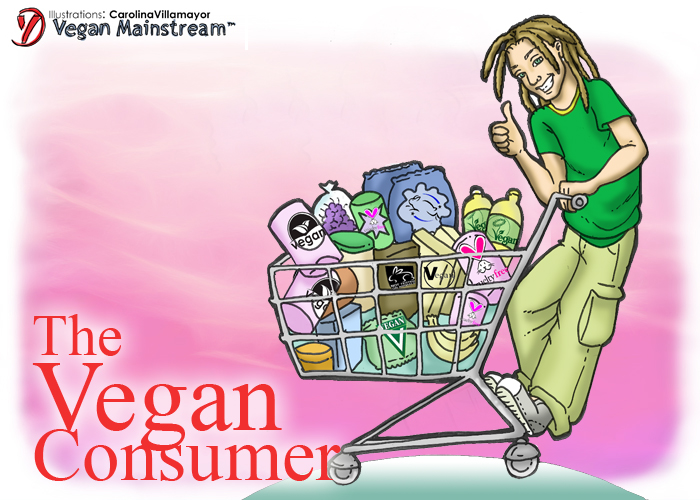
First, many mainstream vegans tend to regard the very culprits of animal exploitation as the remedy. Veganism is now sold to people in the form of products (sometimes explicitly labeled “vegan”) by the very corporations (i.e. Kraft, Dean, Con-Agra, Burger King, etc.) that exist and profit off the exploitation of animals. While the availability and convenience of these products is celebrated as “victories,” their support only sediments the control these corporations have over the market and government. These agri-businesses that own, produce, and distribute most of our food supply have tremendous political power winning government subsidies and combating policy changes that would abolish animal exploitation practices..

Second, even if consumer vegans extend their boycott from the individual product consumed to the company who profits from it, without also challenging the present political-economic order of capitalism in which the interests of corporations persistently trump the interests of the general public, vegans remain complicit in the system that entitles businesses to exploit animal others (and human others as well). Besides, it’s not as if animal agribusiness is an isolated phenomenon; it is sustained by what Barbara Noske calls “the animal industrial complex”—an amalgamation of feed and chemical companies, the pharmaceutical industry, representatives and officers in government, public research and educational institutions etc. that are all mutually dependent upon one another through capital. Animal agribusiness will not be overthrown until these regimes and what gives them power are transformed. Even if consumer vegans were able to make significant dents in the national market, all this will be reversed by the rise of the affluent animal-eating class in the developing world to whom animals raised nationally will be exported, or—in “a race to the bottom”— to where the industry will be exported—displacing farmers and wildlife and externalizing production costs upon their communities.

Third, veganism as an economic boycott does not even universally enable people to practice veganism. Since wholesome food is regarded as a commodity rather than a socio-political right, large populations of disadvantaged people have little to no financial and/or geographic access to vegetarian food and goods, and thus are severely disadvantaged from living a secure vegan life. Food will continue to be grown for profits before people’s needs and preferences so long as food remains a commodity. A vegan world will not be brought about by the asocial, amoral market but by people in what Vandana Shiva calls “food democracy”—when food production and access is determined by people, not the imperialism of the market. In sum, mainstream vegan discourse and activism's focus on economic boycott is problematic not because it is ineffective, but because it is insufficient. Without challenging the political, economic, and social structure of society, veganism as a movement will make little progress reducing and abolishing animal exploitation.

Friday, March 11, 2011

Favorite Human-Animal Relation Quotes

Designed by Christie Nicole and Adam Weitzenfeld
Thought I'd share some quotes I've encountered  researching Human-Animal relations, ethics, and subjectivity as I pull together a post on the moral psychology of animal encounters. Enjoy!

Stories with animals are older than history and better than philosophy.
--Paul Sheppard

The more I spoke about animals, the less possible it became to speak to them.
--David Abram

Man becomes aware of himself returning the [animal’s] look… [Today] animals are always the observed. The fact that they can observe us has lost all significance... The more we know, the further away we are.
--John Berger

The most matter of fact person could not help thinking of the hogs they were so innocent they came so very trustingly and they were so very human in their protests and so perfectly within their rights... It was like some crime committed in a dungeon all unseen and buried out of sight and of memory... Relentless remorseless it was all his protests... his screams were nothing it it did its cruel will with him as if his wishes feelings had simply no existence at all it cut his and watched him gasp out his life

He had stood and watched the hog-killing, and thought how cruel and savage it was, and come away congratulating himself that he was not a hog; now his new acquaintance showed him that a hog was just what he had been--one of the packer's hogs!...What they wanted from a hog was all the profits that could be got out of him; and that's what they wanted form the working man... What the hogs thought of it, and what he suffered, was not considered; and no more was it with the working man... That was true everywhere under capitalism.
--Upton Sinclair

How many of my ancestors
Were treated like today’s farm animals?
How many of us look the other way?
When I hear of calves
Being taken from their mothers
To be sold as veal
I can hear the wailing voices of mothers
Crying for their babies
As the slave master takes them away
The mother cow breastfeeds the human race
My ancestors breastfed the white race
So when I looked into those stunned eyes today,
No one could have said to me,
‘What’s the big deal?’ ‘ It’s only an animal.’
I could have remembered a time
When someone might have said the same thing about me
--Mary Spears

The possibility of the pogrom is decided in the moment when the gaze of a fatally-wounded animal falls on a human being. The defiance with which he repels this gaze—‘after all, it’s only an animal’—reappears irresistibly in cruelties done to human beings, the perpetrators having again and again to reassure themselves that it is ‘only an animal,’ because they could never fully believe this even of animals
--Theodore Adorno

Men do all they can in order to dissimulate this cruelty or to hide it from themselves, in order to organize on a global scale the forgetting or misunderstanding of this violence that some would compare to the worst cases of genocide (there are also animal genocides)… conditions that previous generations would have judged monstrous, outside of every supposed norm of a life proper to animals that are thus exterminated by means of their continued existence or even their overpopulation.

No one can deny the suffering, fear or panic, the terror or fright that humans witness in certain animals… the response to the question "can they suffer?" leaves no doubt… War is waged over the matter of pity… To think the war we find ourselves waging is not only a duty, a responsibility, an obligation, it is also a necessity … I say "to think" this war, because I believe it concerns what we call "thinking."
--Jacques Derrida

There were seventy of us in a forestry commando unit for Jewish prisoners of War in Nazi Germany… halfway through our long captivity, for a few short weeks before the sentinels chased him away, a wandering dog entered our lives... we called him Bobby, an exotic name, as one does with a cherished dog. He would appear at morning assembly and was waiting for us as we returned, jumping up and down and barking in delight. For him, there was no doubt that we were men... This dog was the last Kantian in Nazi Germany, without the brain needed to universalize maxims and drives
--Emmanuel Levinas

However, even vegetarianism in your hands, would make a capital article... its connection with modern socialism, atheism, nihilism, anarchy and other political creeds... Brussels sprouts seem to make people bloodthirsty, and those who live on lentils and artichokes are always calling for the gore of the aristocracy and for the severed heads of kings... in the political sphere a diet of green beans seems dangerous.
--Oscar Wilde

Sunday, January 16, 2011

Decolonization and Animal Liberation: Love, Violence, Becoming-Other-Wise

Beehive Design Collective. "FTAA." Source: www.beehivecollective.org
Introduction
Some cyber-friends have been pestering me to put up another blog post since I haven't posted anything in three months--well, maybe that's an exaggeration but i really wanted to use the word pestering--, so  I'm posting two abstracts I recently submitted to the Thinking About Animals conference at Brock University (St. Catharines, ON, Canada) going on between March 1 and April 1, 2011. This will be the 10th Critical Animal Studies conference, and Brock is perhaps one of the most deserving universities since its establishment of a critical animal studies minor and an official vegan policy in the Sociology department.

On that note, I encourage you to check out the Critical Animal Studies resource page I created over winter break!!!

The first paper, on Frantz Fanon's The Wretched of the Earth, is a paper I wrote for Existentialism in the Fall. I went through some angst writing it, but came out overall satisfied with the paper. If any of you are interested in reading it, I'll send you a copy in exchange for some good feedback. The second paper ought to be more familiar to avid readers of this blog. It's basically a summation of what I have written on the understanding of veganism over the last two years or more.

1.
Decolonization and Animal Liberation:
Violence and Becoming-Animal in Frantz Fanon’s The Wretched of the Earth
In 1961, the Algerian psychoanalysist, Frantz Fanon, published, Les Damnés de la Terre, a book specifically about the revolutionary movement in French Algeria, but a guide to decolonization in general. In The Wretched of the Earth, Fanon gives a phenomenological account of the Algerian independence movement, from its inception in local, spontaneous violent uprisings, to a national political movement, to the development of a national culture and new humanism. For Fanon and his friend Sartre, violence is a necessity for the colonized to become fully human and political subjects. Similarly, the development of a national culture is necessary development for not only the liberation of Algeria, but for the future of humanity.

While Fanon’s primary goals are the achievement of national consciousness and a new humanism, a subversive reading of this text foregrounds “the animal” that beseeches his description of decolonization. Fanon’s characterization of the relationship between decolonization and animals is complex: on the one hand, animal being is to be transcended, if not negated through self-assertion and violence, yet the animal virtues of spontaneity, ferocity, and pack-forming are crucial for the overthrow of the colonizers. If humans’ metaphoric relationship to “animality” and animal others materialize in their relationship with one another, as is argued, then decolonization will not be achieved so long as a hierarchical and exclusionary identity politics exists between human and animal others (as is inferred by Fanon and Sartre’s subject-centered humanist discourse). It is argued that the anarchistic process of “becoming-animal” described by Gilles Deleuze and Félix Guatarri is a more transformative and promising alternative to humanism for not only human liberation, but also the liberation from humanist violence against “animality” and animal others.

2.
Deconstructing Veganism:
Love, Listening, Conversations, and Companionships Beyond Boundaries
For over a decade, Gary Francione (1996, 2008) has been championed for his bold challenge to the efficacy of “new welfarism” and the sufficiency of lacto-ovo-vegetarian advocacy in the contemporary “animal rights” movements. Yet relatively few animal abolitionists have ever challenged the sufficiency and status quo of veganism. In a time when neoliberalism has come into a greater appropriation of veganism (Hammer 2008), real animals have become absent from the discourse of many animal and vegan advocacy campaigns (Adams 2006), and to be a vegan is more about one’s way of life (i.e. the subculture one belongs to) than one’s actual relationship to animals, a more radical critique of not only vegetarianism but veganism too is needed.

While many celebrate the mainstreaming of veganism, I would like to caution self-identified vegans and animal activists from accepting the present understanding of vegan as an identity of (abstention from) consumption. The present understanding of veganism as a) an identity b) defined negatively as an abstention from c) consumption has lead to a certain modality of political and private life which has been legitimately accused of self-righteousness, identity politics, militancy, colonialism, and privileged consumerism. In light of this, we are called to a radical rethinking of veganism not as a noun (“ vegan”) to be identified with, purchased, consumed, and completed, but as a modality and relationship with others that is never yet complete.

Veganism is something to be understood affirmatively, as an affirmation of our own feelings and the voices of others. Those who have come into veganism as a liberation project must adamantly recall that they did not do so because of convenience, out of tradition, or merely out of pleasure, but because they are in search of affirming love. This love must never be forgotten as their point of departure and arrival. The ends of veganism are in the means of not forgetting, disavowing others. It is through disavowal that people commit the most violence by ignoring their own and others’ sentiments; they wage war on themselves and others for foreclosing ends, ideals, and identities, rather than waging conversation. The end of veganism is thus not to become a vegan, but to become other-wise in conversations and companionships beyond boundaries and “language.”